
best free VPN in India in 2026? Whether you want to protect your online privacy, secure your connection on public Wi-Fi, or browse the internet more safely, choosing the right free VPN can make a significant difference. While many free VPNs are available, only a few provide strong security, reliable speeds, and transparent privacy policies without compromising your personal data.

The best free VPNs for India in 2026 offer features such as military-grade encryption, no-logs policies, secure VPN protocols, and apps for Windows, Mac, Android, iPhone, and Linux. Some also provide free servers in multiple countries, allowing users to enjoy safer browsing, improved privacy, and unrestricted access to global websites while traveling. Although free plans usually come with data or server limitations, reputable VPN providers still deliver excellent protection for everyday use.
In this comprehensive guide, you’ll discover the best free VPNs in India for 2026, including their key features, advantages, limitations, pricing, and real-world performance. We’ll compare the top free VPN services based on security, speed, privacy, ease of use, streaming support, and overall value to help you choose the best option for your needs.
Quick Answer
The best free VPNs for India in 2026 are those that prioritize privacy, strong encryption, fast speeds, and a strict no-logs policy. Top choices include Proton VPN Free, Windscribe Free, hide.me Free, PrivadoVPN Free, and TunnelBear Free, each offering different benefits depending on whether your priority is unlimited data, faster performance, or broader server availability.
By the end of this article, you’ll know which free VPN is the best choice for secure browsing, remote work, online privacy, streaming, gaming, and everyday internet use in India throughout 2026.
Why Indians Are Searching for VPNs More Than Ever
A few things have changed the VPN conversation in India over the last couple of years. CERT-In’s data retention rules pushed most VPN companies to pull their physical servers out of the country and switch to virtual India-based IPs instead. Streaming platforms have gotten stricter about detecting VPN traffic. And plain old privacy — not wanting your ISP or a café’s public Wi-Fi to see everything you do — has become a bigger concern for regular people, not just techies.
A VPN helps with three broad things: hiding your browsing from your internet provider, getting around blocked websites, and appearing to browse from a different country (useful for streaming or accessing region-locked apps). A free VPN can do all three, just with real trade-offs in speed, data, and sometimes trust.
Best Free VPN in India in 2026:-
If you only read one section, here it is:
- Best free VPN overall for India: Proton VPN Free — unlimited data, no ads, genuinely private
- Best free VPN for streaming/torrenting: PrivadoVPN Free — fast servers but only 10GB a month
- Best free VPN with the most data: Windscribe Free — 10GB/month and a good app
- Best free VPN for beginners: TunnelBear Free — dead simple, but only 2GB a month
- Best privacy-focused free VPN: hide.me Free — solid no-logs policy, limited server choice
- If you can spend a little: Surfshark is the cheapest capable paid option at roughly ₹150–180/month on its 2-year plan
Now let’s go through each one properly, with the actual pros and cons instead of marketing copy.
1. Proton VPN Free — Best Overall Free VPN
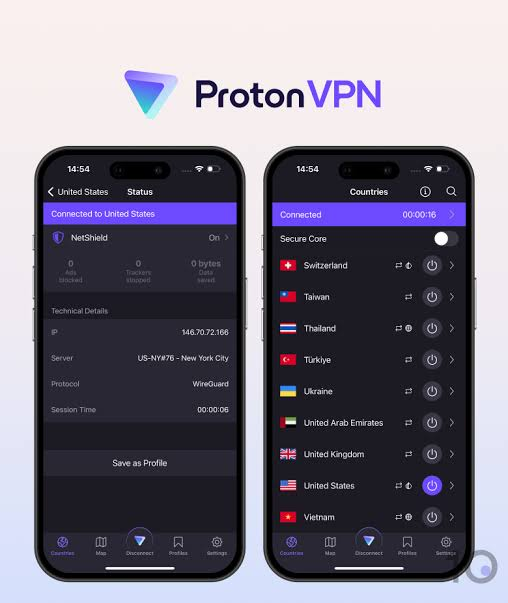
Proton VPN‘s free tier is one of the few in the industry that doesn’t cap your data. You can use it as much as you want, every day, without hitting a wall halfway through the month. It comes from the same company behind Proton Mail, so the privacy credentials aren’t just a claim — they’ve built their whole business around it, and they’re based in Switzerland, which has strong privacy law.
The catch is that the free plan only lets you pick from a handful of countries (not the full server list), and speeds on the free servers can dip during peak hours since so many people share them. Streaming Netflix or Hotstar reliably on the free tier isn’t realistic — think of it as a tool for private browsing, not a Netflix workaround.
Pros
- No data cap, use it daily without limits
- No ads inside the app
- Strong, independently audited no-logs policy
- Works well for basic browsing, banking on public Wi-Fi, checking email securely
Cons
- Limited server locations on the free plan
- Speeds can slow down at busy times
- Not built for streaming or torrenting on free servers
Good example use case: You’re working from a co-working space or a café on shared Wi-Fi and just want your traffic encrypted while you check your bank app or send work emails. Proton’s free plan handles this without you thinking about it again.
2. PrivadoVPN Free — Fastest for Streaming, But Data-Capped
PrivadoVPN throws in a genuinely generous free experience for a limited amount of usage: 10GB a month, access to around a dozen server locations, and speeds that hold up well for streaming and even light torrenting. Testers who’ve tried it on Indian connections report it clearing Netflix and BBC iPlayer without much fuss, at least until the data runs dry.
The problem is obvious — 10GB disappears fast if you’re watching video. It’s roughly two to three movies in HD, or a few hours of regular browsing spread across a month. Once you’re out, you either wait for the reset or upgrade to a paid plan.
Pros
- Fast enough for streaming and torrenting
- More server locations than most free plans
- Supports obfuscation, which helps get around some network-level blocking
Cons
- 10GB monthly cap — runs out quickly with video
- No servers physically inside India
- Free plan pushes upgrade prompts fairly often
Good example use case: You want to check if a show is available on a foreign Netflix library before committing to a subscription, or you need a quick, fast connection for a one-off download. It’s built for short, high-intensity use rather than daily background use.
3. Windscribe Free — Most Generous Data Allowance
Windscribe gives free users 10GB a month too (2GB by default, but it goes up to 10GB if you confirm your email and tweet about it, which is an odd but harmless requirement). It also throws in an ad blocker and split tunneling, features that usually sit behind a paywall elsewhere.

Where it falls short for Indian users specifically is server choice near India — most reviews note it works, but isn’t the fastest option if your priority is a low-latency connection to nearby servers. Still, for the price of ₹0, it’s one of the more feature-complete apps out there.
Pros
- Up to 10GB/month with email verification
- Ad blocker and split tunneling included free
- Unlimited simultaneous connections on some plans
Cons
- Verification step feels unnecessary to some users
- Fewer nearby server options
- Interface has a learning curve compared to simpler apps
Good example use case: You want one VPN app across your phone and laptop that also blocks ads and trackers by default, without paying for a separate ad-blocker extension.
4. TunnelBear Free — Best for Absolute Beginners
TunnelBear is the VPN equivalent of a friendly, oversized “on” button. The app design is playful (literally bear-themed), the settings are minimal, and there’s very little to configure wrong. It includes split tunneling even on the free tier, which is more than most competitors offer at that price.
The trade-off is data: just 2GB a month. That’s enough for checking email and browsing securely, not much beyond that. It’s also worth knowing that TunnelBear, like several others, no longer maintains physical servers inside India due to local data retention requirements — so if you specifically wanted an Indian IP, this isn’t the tool for that.
Pros
- Extremely easy to set up, good for non-technical users
- Clean, simple interface
- Includes split tunneling for free
Cons
- Only 2GB/month — the smallest allowance on this list
- No torrenting support
- No physical India servers
Good example use case: A parent or relative who isn’t comfortable with technical settings but wants a one-tap way to browse more privately on public Wi-Fi at an airport or hotel.
5. hide.me Free — Quietly Strong on Privacy
hide.me doesn’t get as much attention as the bigger names, but its free plan has a decent reputation for actually respecting its no-logs claims, and the company has commissioned independent audits to back that up. Free users get a handful of server locations and a modest data allowance, generally reported at around 10GB a month depending on the plan version at the time.
It’s not the fastest option and the free app doesn’t let you pick your preferred server — it auto-assigns one, which can be frustrating if a particular location matters to you.
Pros
- Strong, audited no-logs policy
- Reasonable free data allowance
- No aggressive upsell tactics inside the app
Cons
- Can’t manually choose your server on the free tier
- Fewer locations than paid competitors
- Speeds are average, not exceptional
Good example use case: Someone who mainly cares about the privacy angle — not wanting an ISP or hotspot provider logging their browsing — and isn’t fussed about picking a specific country to connect through.
What About “100% Free Forever” VPN Apps From the Play Store?
It’s worth a direct warning here, because it comes up constantly in India-specific searches: a lot of random free VPN apps on the Play Store are not safe. Independent researchers have repeatedly found free VPN apps that log user data, inject ads into browsing sessions, or in some cases even sell bandwidth from your phone to third parties without clearly telling you. If an app promises unlimited data, no ads, and no subscription upsell with zero explanation of how that’s financially possible, that’s a red flag, not a bonus.
Stick to VPNs with an established company behind them, a public privacy policy, and (ideally) a completed third-party audit. Every VPN mentioned above meets that bar. Most nameless “Free VPN Master”-style apps do not.
Free vs Paid: What You’re Actually Trading Off
Here’s a straightforward price and feature comparison based on current 2026 pricing for Indian users, converted to rupees:
| VPN | Free Plan Data | Paid Plan (2-yr, ₹/month approx.) | India Virtual Servers | Streaming Support |
|---|---|---|---|---|
| Proton VPN | Unlimited (limited servers) | ~₹350/month | Yes | Free tier: no, Paid: yes |
| PrivadoVPN | 10GB/month | Paid plans vary | Yes | Yes, even on free |
| Windscribe | Up to 10GB/month | ~₹200/month | Limited | Partial |
| TunnelBear | 2GB/month | ~₹300/month | No | No |
| hide.me | ~10GB/month | ~₹250/month | Limited | Partial |
| Surfshark | No free plan | ~₹150–180/month | Yes (virtual) | Yes |
| NordVPN | No free plan (30-day trial) | ~₹260/month | Yes (virtual) | Yes |
| ExpressVPN | No free plan | ~₹550/month | Yes (virtual) | Yes |
A few honest observations from this table:
Free VPNs are genuinely fine for privacy, not for streaming. If your goal is “don’t let my ISP see everything I browse,” any option above works well. If your goal is “watch a foreign Netflix catalogue every week,” you’ll hit data caps fast, and you’re better off paying for something like Surfshark, which currently sits at the cheapest end of the paid market while still allowing unlimited devices on one account.
Surfshark tends to come out as the best value paid option for Indian households specifically because of its unlimited simultaneous device policy — one subscription can cover every phone, laptop, and smart TV in the house, which matters more in India’s typically shared, multi-device households than in single-user Western markets.
NordVPN and ExpressVPN are faster in third-party speed tests, but ExpressVPN in particular carries a noticeably higher price for Indian buyers without a proportionally higher benefit for most casual use cases.
How to Choose the Right One for You
Rather than just picking whatever’s ranked “#1” on a random blog, match the choice to what you’re actually doing:
- Just want privacy on public Wi-Fi (cafés, airports, co-working spaces): Proton VPN Free or hide.me Free
- Occasional streaming or a one-time download job: PrivadoVPN Free, but track your data usage
- Daily use across a phone and laptop with ad-blocking built in: Windscribe Free
- Setting up a VPN for a parent, grandparent, or non-technical friend: TunnelBear Free
- Regular streaming, torrenting, or gaming from India or abroad: Skip free plans entirely and go with Surfshark for value or NordVPN for speed
A Note on Speed and India-Specific Blocks
Because most major VPN providers no longer keep physical servers inside India (a direct result of local data retention rules), what you’re actually connecting to is a “virtual India server” — physically hosted in a nearby country like Singapore or the Netherlands but assigned an Indian IP address. This works fine for most everyday purposes like unblocking a site or appearing to browse from India, but it does add a small amount of latency compared to a true local server. If you’re gaming competitively, that extra 20–40ms can matter; for browsing or streaming, most people won’t notice.
Frequently Asked Questions
Is it legal to use a VPN in India?
Yes. Using a VPN in India is legal for personal use. What changed in recent years is that VPN providers are required to maintain certain user logs under CERT-In directives, which is why many companies pulled their physical servers out of the country rather than comply, switching to virtual India IPs instead.
Can I use a free VPN to watch Netflix or Hotstar?
Sometimes, but not reliably. PrivadoVPN’s free tier has the best track record among the options here for unblocking streaming platforms, but its 10GB monthly cap means you’ll run out fast if you’re watching regularly. For consistent streaming access, a paid plan is the more realistic option.
Do free VPNs sell my data?
The ones covered in this guide — Proton VPN, PrivadoVPN, Windscribe, TunnelBear, and hide.me — have public privacy policies and, in several cases, independent audits confirming they don’t log or sell browsing data. This is very different from unnamed free apps on the Play Store, many of which have been caught doing exactly that. Always check who’s behind an app before installing it.
Why do free VPNs limit data but not speed?
It comes down to running costs. Server infrastructure and bandwidth cost real money, so companies cap how much you can use for free while still giving you full speed within that limit — it keeps the free tier usable without letting it eat into paid infrastructure costs indefinitely.
Is a free VPN safe enough for online banking?
Generally yes, if you’re using an established provider like the ones listed here, since your traffic between your device and the VPN server is encrypted either way. That said, your bank’s own app and website already use HTTPS encryption, so a VPN mainly adds protection against your local network (like public Wi-Fi) snooping on you, rather than protecting the banking connection itself, which is already secured.
What’s the catch with “unlimited free VPN” apps that aren’t on this list?
Usually one of three things: they inject ads, they log and sell browsing data to advertisers, or they’re funded by turning your device into an exit node for other people’s traffic without clearly telling you. If a free VPN doesn’t explain its business model anywhere in its privacy policy, that’s reason enough to avoid it.
Should I just pay for a VPN instead of using a free one?
If you use a VPN occasionally for privacy on public Wi-Fi, a free plan like Proton VPN or hide.me covers you completely. If you stream, torrent, work remotely and need consistent speed, or want an India-based IP with more reliability, paying roughly ₹150–260 a month for Surfshark or NordVPN ends up being worth it fairly quickly — especially split across a household of devices.
Conclusion
There isn’t one single “best” free VPN for everyone in India — it depends on whether you care more about unlimited usage (Proton VPN), raw speed for streaming (PrivadoVPN), a generous data cushion (Windscribe), simplicity (TunnelBear), or privacy credentials (hide.me). What matters more than picking the “top-ranked” option is understanding what you’re giving up on a free plan — data caps, fewer servers, and slower speeds during peak hours — and deciding honestly whether that trade-off fits how you actually use the internet. For light, occasional use, free is genuinely enough. For anything heavier, it’s worth budgeting the price of a couple of chai a month for a paid plan instead.