
Artbreeder is a unique AI-powered creative tool that allows users to generate and modify images by blending and evolving existing visuals. Unlike traditional text-to-image generators, Artbreeder focuses on “image breeding,” where users can mix different images and adjust various parameters—such as age, gender, color, style, and facial features—to create entirely new results. It uses advanced machine learning techniques similar to Generative Adversarial Networks to produce highly realistic or artistic outputs.
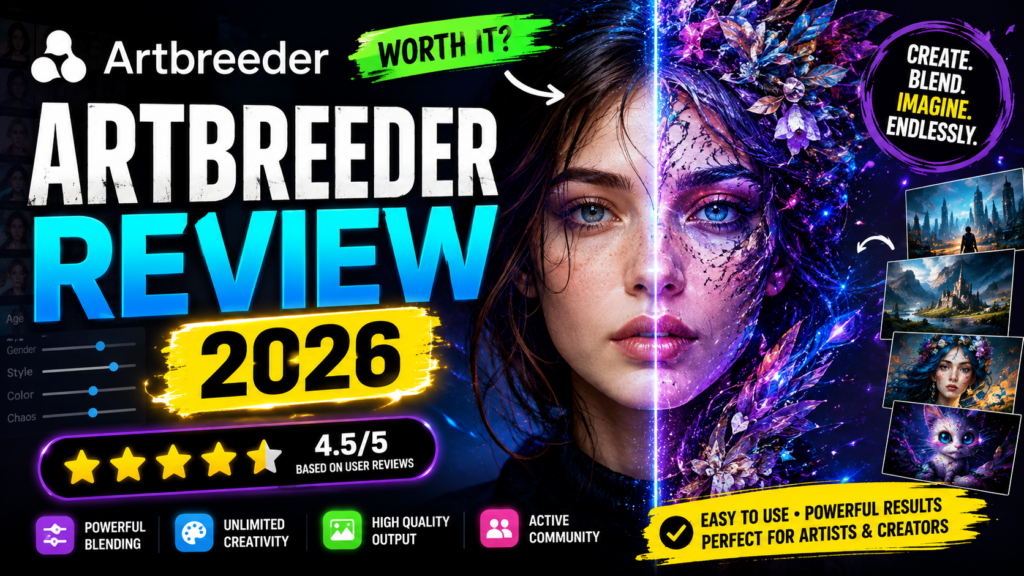
Artbreeder Review 2026: The platform is especially popular for creating portraits, characters, landscapes, and anime-style images. Users can start with a base image and then fine-tune it using simple sliders, making it easy even for beginners to experiment and create customized visuals. Artbreeder also allows users to collaborate by building on images created by others, which encourages creativity and exploration within its community.
Since it is browser-based, there is no need for installation, and it offers both free and premium plans with additional features and higher resolution outputs. However, it may not provide as much control for detailed prompt-based generation compared to tools like Stable Diffusion. Overall, Artbreeder is a powerful and creative platform for anyone interested in exploring AI-generated art through image mixing and customization. Nightcafe
What is Artbreeder?
Artbreeder is an AI-powered image creation and remixing platform founded by Joel Simon in 2018. <cite index=”14-1″>With over 10 million users and a repository of more than 250 million images</cite>, it is one of the most established community-driven AI art platforms in the world.
<cite index=”12-1″>Artbreeder uses Generative Adversarial Networks (GANs) like BigGAN and StyleGAN to make images.</cite> Its core concept is different from most AI image tools: instead of typing a prompt and receiving a generated image, you start with an existing image — or blend two images — and adjust “gene” sliders that control visual characteristics like age, expression, color, style, and mood.
<cite index=”11-1″>The platform is especially popular for creating portraits, characters, landscapes, and anime-style images. Users can start with a base image and then fine-tune it using simple sliders, making it easy even for beginners to experiment and create customized visuals.</cite>
Artbreeder is entirely browser-based — no installation required — and built around a community where users share, remix, and build on each other’s creations.

Artbreeder is an online creative tool that lets you generate and modify images by blending multiple visuals and adjusting their features using simple sliders. Instead of relying only on text prompts, it gives you a more interactive way to design images, especially faces and characters.
It’s widely used for creating:
- Realistic human portraits
- Anime characters
- Landscapes and abstract art
Who is it for?
Artbreeder is best suited for:
- Artists and illustrators
- Writers creating fictional characters
- Game developers
- Content creators
- Beginners who want an easy design tool
It’s perfect for users who enjoy hands-on editing and experimentation.
Why is it popular in 2026?
Artbreeder continues to be popular in 2026 because:
- Unique image “mixing” system
- Beginner-friendly interface
- Fast and interactive editing
- Strong creative community
- Great for character design
2. Key Features in 2026
1. Mixer (Image Breeding)
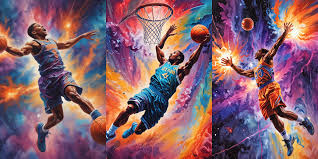
<cite index=”13-1″>Image breeding is Artbreeder’s core concept. You take two images and combine them, creating offspring that inherit traits from both parents. A portrait can be bred with a landscape to create surreal hybrid art. You control how much influence each parent has. The results are unpredictable in a fun way — sometimes you get something mediocre, sometimes something genuinely surprising. The idea is to iterate: breed, select favorites, breed again.</cite>
This is unlike anything else in the AI art space. You are not generating from scratch — you are evolving images through selective combination. The Mixer is what made Artbreeder famous, and it remains its most distinctive feature.
2. Gene Sliders (Splicer)
The Splicer lets you adjust an image’s visual “genes” using sliders. For portraits, you can control age, gender, ethnicity, hair color, facial structure, expression, and more. For landscapes, you control terrain type, lighting, season, and atmosphere.
This slider-based approach has a key advantage over prompt engineering: it is immediate, visual, and requires no technical vocabulary. Moving a slider and seeing the result in real time is more intuitive than writing and rewriting text prompts.
3. Collager
<cite index=”12-1″>The Collager lets users assemble shapes, images, and text into a collage.</cite> You build a rough composition from shapes and reference images, then Artbreeder’s AI transforms it into a coherent image. This is useful for concept artists who want to sketch a composition and have AI render it into a finished piece.
4. Tuner
<cite index=”14-1″>The Tuner provides fine-tuned control over the art creation process, enabling precise adjustments and customization.</cite> It gives more granular control than the basic gene sliders, letting advanced users push specific characteristics further than the standard interface allows.
5. Text + Image Generation (Patterns)
<cite index=”12-1″>Patterns combines patterns with descriptions to generate unique images, expanding creative possibilities.</cite> This is Artbreeder’s text-to-image feature — type a description and receive a generated image. The quality is functional but not at the level of Midjourney or DALL-E 3 for complex scenes.
6. Image Outpainting (Expand)
<cite index=”12-1″>Artbreeder’s Expand feature extends any Artbreeder image</cite> beyond its original borders — similar to Generative Expand in Photoshop. You can extend a portrait into a full scene or widen a landscape for a panoramic composition.
7. Community and Remixing
<cite index=”13-1″>Millions of images created by users are publicly available to remix, breed, and evolve. See a portrait you like? Cross-breed it with a landscape. Take someone’s abstract art and push the color genes. The entire platform is built on the idea that creative works improve through iteration and recombination. It’s one of the few AI art platforms where the community isn’t just sharing results — they’re actively building on each other’s work.</cite>
The community library is a genuine creative resource — a starting point for anyone who wants to begin with strong material rather than generating from scratch.
8. Face Maker
<cite index=”8-1″>The Artbreeder face maker is one of the standout features, allowing users to create realistic faces from simple images easily.</cite> Character creators, game developers, and writers use this to generate consistent character portraits without hiring illustrators.
3. How It Works (Step-by-Step)

Step 1: Create an Account
Sign up on the Artbreeder platform.
Step 2: Choose a Category
Select what you want to create:
- Portraits
- Landscapes
- Anime
Step 3: Pick or Upload an Image
Choose an existing image or upload your own.
Step 4: Adjust Sliders
Modify features like:
- Facial expression
- Lighting
- Color tones
Step 5: Mix Images
Blend multiple images to create new variations.
Step 6: Save and Download
Download your final design or share it with the community.
4. Performance & Speed
Image Quality
Artbreeder offers:
- High-quality portraits
- Smooth blending of features
- Unique and creative outputs
Best for:
- Character design
- Concept art
Speed
- Instant preview updates
- Fast processing
- No long wait times
Reliability
- Stable cloud platform
- Smooth performance
- Minimal downtime
5. Pricing & Plans
Artbreeder uses a credit-based subscription model. Credits are consumed each time you generate or download an image.
<cite index=”13-1″>Free accounts get 3 credits per month — enough to dip your toes in but not enough for serious work. The Starter plan at $8.99/month provides 100 credits. Advanced at $18.99/month gives 275 credits. Champion at $38.99/month offers 700 credits plus high-resolution downloads.</cite>
| Plan | Price | Credits/Month | Key Features |
|---|---|---|---|
| Free | $0 | 3 credits | Basic access, watermarked downloads, community library |
| Starter | $8.99/month | 100 credits | No watermark, higher resolution, all tools |
| Advanced | $18.99/month | 275 credits | More credits, priority generation, high-res downloads |
| Champion | $38.99/month | 700 credits | Maximum credits, highest resolution, all features |
Approximate INR pricing:
- Starter: ~₹750/month
- Advanced: ~₹1,580/month
- Champion: ~₹3,250/month
Free plan reality: <cite index=”13-1″>3 credits per month is enough to dip your toes in but not enough for serious work.</cite> Each generation typically costs 1 credit. With 3 credits, you get 3 generations per month — essentially a sampler rather than a working plan.
Credit consumption: Standard image generation uses 1 credit. Higher resolution outputs and certain tools use more. Heavy users — character artists producing many variations — will find even the Advanced plan limiting.
Commercial use: Check Artbreeder’s current terms of service for commercial use rights. The terms have evolved and differ by plan — verify before using generated images in commercial projects.
Is it worth the money?
Yes, if you:
- Create characters frequently
- Need better quality exports
For casual users, the free version is usually enough.
6. Pros and Cons
Pros
Unique slider-based image evolution — Artbreeder’s gene slider approach has no equivalent in the AI art space. For users who find prompt engineering frustrating or inaccessible, the ability to adjust visual characteristics with sliders and see immediate results is genuinely liberating. No learning curve for the core interaction.
Excellent for portrait and character creation — <cite index=”8-1″>The face maker allows users to create realistic faces from simple images easily, which is especially useful for designers working on game development.</cite> Writers, tabletop RPG players, game developers, and novelists use Artbreeder extensively for character visualization.
Massive community library — Over 250 million images available to remix means you are rarely starting from nothing. Finding a strong base image and evolving it is faster than generating from scratch and produces more controlled results.
Genuinely affordable entry price — At $8.99/month for the Starter plan (~₹750/month), Artbreeder is significantly cheaper than Midjourney ($10/month) and DALL-E via ChatGPT Plus ($20/month). <cite index=”13-1″>For professional use, these prices are very low.</cite>
No technical skills required — <cite index=”11-1″>It’s very easy to use and doesn’t require technical skills. Its slider-based editing and image blending system make it different from most tools.</cite> Artbreeder is one of the most accessible AI art tools for complete beginners.
Browser-based, no installation — Works on any device with a browser. No GPU requirements, no complex setup, no software installation.
Community-driven creativity — The remixing ecosystem means your work becomes part of a living creative conversation. Others build on your images; you build on theirs. This collaborative dynamic is unusual and valuable for creative exploration.
Cons
Image quality below Midjourney and DALL-E 3 — <cite index=”13-1″>Image quality and resolution are significantly lower than Midjourney or DALL-E output.</cite> For professional creative work requiring high-fidelity photorealistic images or complex scene generation, Artbreeder’s output quality does not compete with the leading text-to-image generators.
Very limited free plan — 3 credits per month is barely enough to evaluate the platform properly. Most AI art tools offer more meaningful free access. Artbreeder’s free plan is more of a teaser than a functional tier.
Credit system limits creative exploration — AI art creation is inherently iterative — you make many images to find a few good ones. A credit system that counts every generation discourages the rapid experimentation that produces the best results. Heavy explorers will burn through credits quickly.
Limited prompt-based generation quality — <cite index=”11-1″>It may not provide as much control for detailed prompt-based generation compared to tools like Stable Diffusion.</cite> Artbreeder’s text-to-image features are secondary to its blending tools — users who primarily want text-to-image generation are better served by dedicated tools.
Less suitable for complex scene composition — Artbreeder excels at portraits, characters, and stylized landscapes. Complex scenes with multiple elements, specific spatial arrangements, or detailed environments are harder to achieve through gene sliders than through prompt-based generation in Midjourney or DALL-E.
Public by default — Images created on Artbreeder are public by default on most plans. For users who want to keep their creative work private, this is a significant limitation. Check plan terms for private generation options.
Older GAN-based technology — Artbreeder’s core technology (BigGAN, StyleGAN) predates the diffusion models now used by Midjourney, DALL-E, and Stable Diffusion. The output aesthetic reflects this — distinctive but not at the frontier of AI image quality in 2026.
7. Best Use Cases
Who should use Artbreeder?
- Writers building characters
- Game developers
- Artists exploring ideas
- Beginners experimenting with visuals
Who should avoid it?
- Users needing realistic full-scene images
- Professionals needing precise control
- Advanced designers wanting deep customization
8. Comparison with Competitors
Artbreeder vs Midjourney
Midjourney produces dramatically higher quality images, particularly for complex scenes, photorealism, and stylized artistic output. Artbreeder wins on accessibility (no prompt engineering), community remixing, and price. For professional-quality AI art, Midjourney is the stronger tool. For character exploration, portrait generation, and creative experimentation without technical complexity, Artbreeder has a distinct appeal.
Artbreeder vs DALL-E 3 (ChatGPT)
DALL-E 3 excels at following complex text instructions and generating diverse scene types with high accuracy. Artbreeder’s slider-based approach produces more controllable, iterative results for portrait and character work. DALL-E 3 is better for one-shot generation from detailed descriptions; Artbreeder is better for iterative character development and image evolution.
Artbreeder vs Stable Diffusion
<cite index=”11-1″>Artbreeder is easier, while Stable Diffusion offers more advanced control.</cite> Stable Diffusion is open-source and infinitely customizable with community models — but requires technical setup. Artbreeder requires no setup and produces results immediately. For non-technical users, Artbreeder’s accessibility advantage is significant.
Artbreeder vs Adobe Firefly
Adobe Firefly is commercially safe (trained on licensed content) and deeply integrated into the Adobe creative ecosystem. Artbreeder’s community-remixing model raises more complex commercial use questions. Firefly wins for professional commercial work in the Adobe ecosystem. Artbreeder wins for creative exploration, character creation, and community engagement.
9. Security & Privacy
Artbreeder offers basic security features:
- Cloud-based system
- User account protection
However:
- Images are stored online
- Avoid uploading sensitive or private content
10. Final Verdict
Artbreeder is a creative and beginner-friendly tool that shines in character design and image blending.
It may not replace advanced tools, but it excels in:
- Simplicity
- Creativity
- Fast results
Is it worth using?
Yes, especially for beginners and creative users.
Recommendation:
- Beginners → Great starting point
- Creators → Useful for character design and inspiration
Who Should Use Artbreeder?
Strongly recommended for:
- Writers and novelists who want to visualize characters without drawing skills
- Tabletop RPG players and game masters creating character and NPC portraits
- Game developers prototyping character designs
- Digital artists who enjoy iterative, experimental creative processes
- Educators and students exploring AI art concepts
- Hobbyists who want to create AI art without learning prompt engineering
Worth considering if:
- You want a large community library of images to remix and evolve
- You need an affordable entry point into AI image creation
- You are creating portrait-based content at moderate volume
Look elsewhere if:
- You need professional-grade photorealistic image quality (try Midjourney)
- You primarily want text-to-image generation with detailed prompt control (try DALL-E 3 or Midjourney)
- You need commercially clear images for client work (try Adobe Firefly)
- You want maximum creative control and technical flexibility (try Stable Diffusion)
- You need privacy for your generated images (check plan terms carefully)
11. FAQs
1. What is Artbreeder used for?
Artbreeder is used to create and edit images by blending and adjusting features like faces, landscapes, and styles.
2. Is Artbreeder free?
Yes, it offers a free plan with limited features and credits.
3. Can beginners use Artbreeder?
Yes, it’s very easy to use and doesn’t require technical skills.
4. What makes Artbreeder unique?
Its slider-based editing and image blending system make it different from most tools.
5. Can I create realistic faces?
Yes, Artbreeder is especially strong at generating realistic portraits.
6. Do I need a powerful computer?
No, it works entirely online.
7. Can I use Artbreeder images commercially?
You should check the platform’s terms before using images for commercial purposes.
8. Is Artbreeder better than Stable Diffusion?
It depends—Artbreeder is easier, while Stable Diffusion offers more advanced control.
9. Can I upload my own images?
Yes, you can upload and modify your own images.
10. Is Artbreeder worth it in 2026?
Yes, especially for creative experimentation and character design.
11. Is Artbreeder free to use?
Yes. Artbreeder has a free plan with 3 credits per month. This is enough to explore the platform but not for regular creative work. The Starter plan at $8.99/month (~₹750/month) provides 100 credits and is the minimum for practical use.
12: Can I use Artbreeder images commercially?
Commercial use rights depend on your plan and Artbreeder’s current terms of service. Check the terms carefully before using generated images in commercial projects, as the policy has evolved and differs by subscription tier.
13: Does Artbreeder require design or technical skills?
No. <cite index=”11-1″>Artbreeder is very easy to use and doesn’t require technical skills. Its slider-based editing and image blending system make it different from most tools.</cite> It is one of the most beginner-accessible AI art platforms available.
14: Is Artbreeder good for creating realistic portraits?
<cite index=”11-1″>Yes, Artbreeder is especially strong at generating realistic portraits.</cite> The Face Maker and gene slider system give fine-grained control over facial features that other tools do not match through prompt engineering alone.
15: Is Artbreeder available in India?
Yes. Artbreeder is browser-based and accessible globally, including from India. Subscription payments are in USD. The Starter plan at $8.99/month converts to approximately ₹750/month.
16: How does Artbreeder’s credit system work?
Each image generation or download costs credits. Standard generations cost 1 credit; higher resolution outputs cost more. Free accounts receive 3 credits per month. Paid plans range from 100 to 700 credits per month depending on the tier.
17: Can I upload my own images to Artbreeder?
<cite index=”11-1″>Yes, you can upload and modify your own images</cite> in Artbreeder. You can use your own photos or artwork as a starting point for breeding and gene adjustment.
Conclsion
Artbreeder in 2026 occupies a specific and valuable creative niche. Its slider-based image breeding approach, massive community library, and accessible price point make it genuinely distinctive in a market dominated by prompt-based generators.
It is not the tool for professional photorealistic image generation — Midjourney and Adobe Firefly are significantly stronger there. It is not the most technically powerful or flexible — Stable Diffusion wins that comparison. But for creative exploration, character visualization, portrait generation, and iterative image evolution without technical complexity, Artbreeder remains uniquely suited.
<cite index=”13-1″>Artbreeder is best suited for hobbyists and beginners who want to play with AI art without learning prompts.</cite> At $8.99/month for 100 credits, the price is low enough that the limitations are easy to accept. For writers building a character library, game developers sketching concepts, or anyone who wants to experiment with AI art without reading prompt engineering guides, Artbreeder delivers genuine value in a format nobody else offers.