Abstract writing is one of the most challenging and highest-stakes writing tasks in academia and research — a 150–300 word summary that determines whether your paper gets read, your conference submission gets accepted, or your grant proposal advances to the next round. The abstract must communicate research purpose, methodology, key findings, and significance in minimal words while optimizing for the specific requirements of different submission venues.
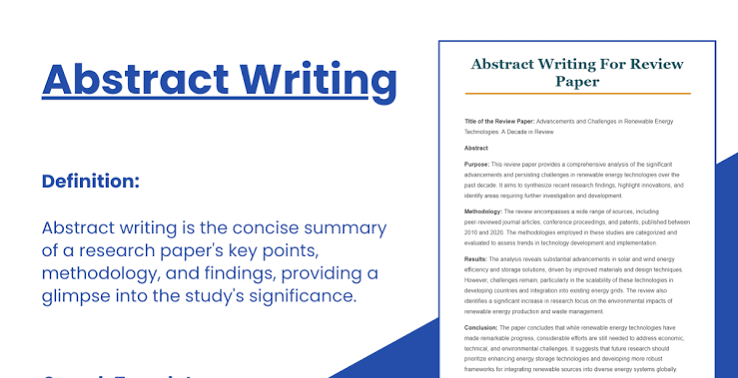
In 2026, artificial intelligence has become a powerful ally for abstract writing — helping researchers structure arguments more clearly, identify the most impactful findings to highlight, optimize word count, and tailor abstracts to specific journal or conference requirements. However, AI for abstract writing requires careful use—the abstract must accurately represent your research, and AI-generated content must be rigorously reviewed for factual accuracy.
This guide covers the best AI tools for abstract writing in 2026 — from general AI assistants to specialized academic writing tools.
Types of Abstracts AI Helps With
Descriptive abstract: Describes what the paper covers without reporting results — conferences, book chapters.
Informative abstract: Complete summary including methods, results, conclusions — journal papers.
Structured abstract: Labeled sections (Background, Methods, Results, Conclusions) — medical journals, systematic reviews.
Conference abstract: Shorter, impact-focused, often with strict word/character limits.
Grant abstract: Funding-focused, emphasizes significance and innovation.
Dissertation abstract: Comprehensive but concise summary of entire thesis.
What Makes a Good Abstract
Before AI tools — understand what a good abstract requires:
Essential elements (IMRaD for informative):
- Introduction/Background: Why was this study needed?
- Methods: How was it conducted?
- Results: What was found?
- Discussion/Conclusion: What does it mean?
Common abstract mistakes AI helps fix:
- Too vague (“results were significant”) → too specific numbers
- Passive voice overuse → active voice
- Missing key finding → lead with most important result
- Exceeding word limit → precise cutting
- Jargon without explanation → clarity for broader audience
Best AI Tools for Abstract Writing in 2026
AI Writing Assistants for Abstract Writing
1. Claude — Best AI for Abstract Writing
Claude is the most capable AI assistant for abstract writing — understanding research context, maintaining academic tone, and producing precisely worded abstracts that stay within word limits.
Abstract writing capabilities:
Complete abstract generation:
Write a 250-word informative abstract for this research paper.

Paper details:
- Research question: [your question]
- Methods: [brief description]
- Key findings: [main results with numbers]
- Conclusions: [main implications]
- Journal: [target journal name]

Requirements:
- Past tense for methods and results
- Present tense for conclusions and implications
- No citations in abstract
- No abbreviations without definition
- Stay under 250 words
- Active voice where possible
Structured abstract:
Convert this abstract to structured format
required by [journal name]:

Sections needed:
- Background
- Objective
- Methods
- Results
- Conclusions

Current abstract: [paste abstract]

Maintain all key information.
Stay within 300-word limit.
Abstract revision:
Revise this abstract for these issues:
1. Too long (currently 320 words, need 250)
2. Methods section too detailed
3. Results not prominent enough
4. Missing clinical significance statement

Current abstract: [paste]
Target: [journal requirements]
Conference abstract:
Write a 150-word conference abstract for
[Conference Name] submission.

Focus on:
- Novelty of approach
- Key finding (one main result)
- Broader significance
- Impact on field

Research summary: [paste key points]
Grant abstract:
Write a 200-word grant abstract for
[funding agency] application.

Emphasize:
- Significance and innovation
- Public health/social impact
- Clear research gap addressed
- Expected outcomes

Research proposal summary: [paste]
Keyword optimization:
“Suggest 5–8 MeSH terms/keywords for this abstract that maximize discoverability in PubMed/Google Scholar: [paste abstract]..”
Word count precision:
Claude consistently hits target word counts — critical for journals with strict limits.
Free plan: Claude free handles all abstract writing tasks effectively.
Best for: All abstract writing needs — Claude’s precision, understanding of academic tone, and word-count accuracy make it the most reliable AI for abstract writing.
2. ChatGPT — Best for Abstract Brainstorming and Variation
ChatGPT excels at generating multiple abstract versions and exploring different framings of the same research.
ChatGPT is a versatile conversational tool for abstract brainstorming, idea generation, and creative variation. It can help users explore a topic from multiple angles, turn a basic concept into several different ideas, and develop rough thoughts into clearer outlines. This makes it useful for writers, students, marketers, creators, entrepreneurs, and professionals who need to generate options quickly.
One of ChatGPT’s main strengths is variation. Instead of producing only one answer, users can ask for different tones, formats, perspectives, examples, headlines, hooks, or approaches. For example, a content creator can provide one topic and request 10 different article ideas, while a business owner can ask for several possible names, taglines, or campaign concepts.
ChatGPT can also help with abstract thinking by connecting unrelated concepts, identifying patterns, asking useful questions, and exploring hypothetical scenarios. It can turn a vague thought such as “I want to build an online business” into possible niches, content ideas, customer problems, and business models.
For brainstorming, the best results usually come from giving ChatGPT some context and then refining the output through follow-up prompts. Users should still review generated ideas for accuracy, originality, and practicality, especially when the ideas involve factual claims or business decisions.
Abstract writing capabilities:
Multiple version generation:
“Write 3 different versions of an abstract for this paper — one emphasizing methodology, one emphasizing clinical implications, one emphasizing novelty: [paste research summary].
Angle exploration:
“What are 5 different ways to frame the main finding of this research for different audiences (clinicians, policymakers, general public, fellow researchers)?”
Title and abstract alignment:
“Does this abstract accurately and completely reflect what the title promises? Identify any misalignment: [paste title and abstract..].”
Journal-specific tailoring:
“Rewrite this abstract to match the style and focus of [journal name]. Here are 3 sample abstracts from that journal: [paste examples]..”
Free plan: ChatGPT free handles abstract generation and variation effectively.
Best for: Generating multiple abstract versions for comparison — ChatGPT’s variation generation helps researchers find the strongest framing.
3. Grammarly — Best for Abstract Editing and Quality
Grammarly provides essential abstract editing — catching grammar errors, improving clarity, and maintaining professional tone in the highest-stakes short text you’ll write.
Abstract editing capabilities:
Clarity scoring:
Abstract receives a clarity score → identifies complex sentences that obscure meaning → specific rewrites suggested.
Conciseness:
Identifies wordy phrases → suggests concise alternatives → critical for word-limited abstracts:
- “to” → “to”
- “because” → “because”
- “conducted an investigation of” → “investigated”
Academic tone:
Flags casual language inappropriate for an academic abstract → formal alternatives suggested.
Passive voice:
Identifies excessive passive voice → active alternatives → more direct abstract.
Grammar accuracy:
Zero grammar errors in abstract — Grammarly catches everything before submission.
Plagiarism check:
Essential if incorporating text from your own previous work — self-plagiarism detection.
Pricing: Free (basic). Premium from $12/month annual.
Best for: Final abstract editing before submission — Grammarly’s quality control catches errors that compromise abstract professionalism.
Specialized Academic Abstract Tools
4. Paperpal — Best Dedicated Academic Writing AI
Paperpal is specifically designed for academic writing — abstract writing assistance with journal-specific guidance.
Abstract-specific capabilities:
Abstract builder:
Fill in structured fields:
- Research purpose
- Methods used
- Key findings
- Main conclusions
Paperpal generates → journal-appropriate abstract → correctly structured.
Journal match:
Enter target journal → Paperpal adjusts abstract style and length → publication-ready formatting.
Language enhancement:
Academic English improvement → non-native English speaker support → particularly valuable for Indian researchers.
Consistency check:
Verifies the abstract consistently represents the paper content → catches discrepancies.
Keyword suggestions:
Suggests keywords based on abstract content → optimize for journal indexing.
Pricing: Free (limited). Essential from $12/month.
Best for: Non-native English-speaking researchers — Paperpal’s academic English enhancement is most valuable for Indian researchers submitting to international journals.
5. Writefull — Best AI for Academic Abstract Quality
Writefull provides AI-powered academic language suggestions specifically trained on published research papers.
Abstract writing capabilities:
Paraphrase:
Rewrite any abstract sentence in a more academic style — trained on millions of published papers.
Abstract generator:
Input paper sections → Writefull generates an abstract → matches published paper style in target field.
Language check:
Field-specific language suggestions — “in biology, researchers say X rather than Y”:
- Medicine/clinical: Precise clinical terminology
- Engineering: Technical accuracy
- Social sciences: Appropriate hedging language
Sentence starters:
Suggests appropriate academic sentence starters for each abstract section — matches field conventions.
Word length checker:
Real-time word/character counting → stay within limits.
Pricing: Free (Writefull for Overleaf). Premium from $9.95/month.
Best for: Researchers wanting field-specific academic language — Writefull’s training on published papers produces the most authentic academic style.
6. Jenni AI — Best for Abstract + Full Paper Writing
Jenni AI combines abstract writing with full paper support — maintains consistency between abstract and paper content.
Abstract capabilities:
Context-aware abstract:
Jenni reads your paper content → generates an abstract that accurately reflects actual content → reduces risk of misrepresentation.
Section alignment:
Verifies abstract matches paper’s actual methods, results, and conclusions.
Citation-free check:
Ensures no citations appear in abstract (common mistake).
Multiple formats:
Structured, informative, or descriptive — generate in required format.
Pricing: Free (limited). Basic from $12/month.
Best for: Researchers writing a full paper in Jenni — abstract generation benefits from whole-paper context awareness.
AI for Specific Abstract Types
Medical/Clinical Abstract
Structured format (most medical journals):
Write a structured abstract for
[New England Journal of Medicine / Lancet / BMJ]

Format required:
BACKGROUND: [1-2 sentences]
METHODS: [3-4 sentences]
RESULTS: [3-4 sentences with statistics]
CONCLUSIONS: [1-2 sentences]

Total: 250 words

Study details:
- Study design: [RCT/cohort/meta-analysis]
- Population: [N, demographics]
- Intervention: [describe]
- Primary outcome: [result with confidence interval]
- Secondary outcomes: [key results]
- Conclusions: [main clinical implication]
Statistical precision:
Claude and ChatGPT maintain statistical notation accurately — p-values, confidence intervals, effect sizes.
Conference Abstract (Oral/Poster)
Write a 150-word conference abstract
for [Conference Name] submission.

Conference focus: [field and theme]
Submission category: [oral/poster]

Research:
- Background: [1 sentence]
- Objective: [1 sentence]
- Methods: [2-3 sentences]
- Results: [2-3 sentences, key finding]
- Significance: [1-2 sentences]

Emphasize novelty and impact.
Reviewers scan quickly — lead with most impressive finding.
Systematic Review Abstract
Write a PRISMA-compliant abstract for
this systematic review and meta-analysis.

Include:
- Registration number (PROSPERO)
- Eligibility criteria
- Information sources
- Risk of bias assessment
- Number of studies included
- Main meta-analysis result (pooled estimate, CI, I²)
- Conclusion and certainty of evidence

Study details: [paste]
Word limit: 300 words
Grant Abstract (NIH/ICMR Style)
NIH Specific Aims page (not traditional abstract but equivalent):
Write a 1-page NIH Specific Aims equivalent for:

Research gap: [describe]
Hypothesis: [state hypothesis]
Aims:
1. [Aim 1]
2. [Aim 2]
3. [Aim 3]

Expected outcomes and innovation: [describe]
Impact: [public health significance]

Tone: Confident, specific, compelling
Avoid: Passive voice, vague statements
Abstract Writing Tips — Working with AI
Tip 1 — Always Start with Your Own Draft
Write a rough abstract first → then use AI to improve:
- AI cannot know your research better than you
- AI starting from scratch may misrepresent research
- Your draft + AI editing = most accurate result
Tip 2 — Provide Maximum Context
Better context → better abstract:
Research question: [specific question]
Methods: [design, n, measures]
Key finding 1: [with exact statistics]
Key finding 2: [with statistics]
Clinical/practical significance: [describe]
Target journal: [name]
Word limit: [exact number]
Tip 3 — Verify Every Claim
AI-generated abstract must match paper exactly:
- All statistics correct
- Methods accurately described
- Conclusions supported by results
- No overclaiming or underclaiming
Tip 4 — Multiple Iteration Approach
Round 1: Generate first draft from Claude
Round 2: Ask ChatGPT to identify weaknesses
Round 3: Grammarly polish
Round 4: Writefull academic language check
Round 5: Final human review
Tip 5 — Check Journal-Specific Requirements
Each journal has specific abstract requirements:
- Word/character limits
- Structured vs unstructured
- Specific section labels
- Abbreviation policies
- Keywords format
Provide requirements to AI before generation.
Abstract Word Count Optimization
Cutting Overlong Abstracts with AI
This abstract is 340 words.
Target: 250 words.
Cut 90 words while preserving ALL key information.

Priority to preserve:
1. Primary outcome with statistics
2. Study design and population
3. Main conclusion

Can cut:
- Secondary outcomes if necessary
- Methodological details
- Background detail

Abstract: [paste]
Claude Word Count Accuracy
Claude is most accurate for hitting precise word counts:
“Rewrite this abstract in exactly 248 words — not more, not less. Here is the current 310-word version: [paste]..”
Claude consistently achieves ±5 words of the target — critical for strict journals.
AI Abstract Writing for Indian Researchers
Challenges for Indian Researchers
Non-native English: Academic English conventions differ from everyday English — AI helps bridge the gap.
Journal-specific style: International journals have specific abstract conventions — AI trained on published papers helps match style.
Word economy: Indian academic writing is sometimes verbose — AI helps achieve the precision required for international abstracts.
ICMR/DBT Grant Abstract
Indian government research grants have specific formats:
Write an abstract for ICMR [scheme name] grant application.

Format: 300 words
Include:
- Scientific rationale
- Objectives
- Methodology overview
- Expected outcomes
- Translational potential for India
- Budget justification summary

Research proposal: [paste key points]
Free AI Abstract Writing Stack
| Tool | Function | Cost |
|---|---|---|
| Claude free | Primary abstract generation | Free |
| ChatGPT free | Alternative versions + brainstorming | Free |
| Grammarly free | Grammar and basic editing | Free |
| Writefull (Overleaf) | Academic language check | Free |
| Word counter tools | Precise word counting | Free |
Complete free stack covers: Generation, variation, editing, academic language — all abstract writing needs at zero cost.
Frequently Asked Questions
Which AI tool is best for writing research abstracts in 2026?
Claude is best for primary abstract generation — most accurate word count targeting, strongest academic tone, best at maintaining informative abstract structure. Grammarly is essential for editing — catches grammar errors in highest-stakes short text. Paperpal is best for Indian researchers targeting international journals — academic English enhancement specifically valuable for non-native speakers.
Can AI write my abstract for me?
AI can generate a strong first draft from your research details — but you must provide accurate information and verify every claim in the output. AI cannot know your research — it synthesizes what you tell it. Use AI to improve clarity, structure, and word economy of information you provide, not to generate research claims independently. The final abstract must accurately represent the actual paper content.
How do I use AI to shorten an overlong abstract?
Paste abstract into Claude with instruction: “Reduce this [N]-word abstract to exactly [target] words. Preserve: [list priorities]. Cut from: [list less critical elements]. Do not change meaning or remove key findings.” Claude’s word count precision is best among AI tools for hitting exact targets required by journal submission systems.
Which AI tool is best for medical/clinical abstracts?
Claude for structured medical abstract generation — handles IMRaD and CONSORT formats accurately. Paperpal for medical journal-specific style matching. Writefull for clinical terminology accuracy. Grammarly Premium for final editing. All four together cover a complete clinical abstract quality assurance pipeline.
Is it ethical to use AI for abstract writing?
Most journals allow AI as a writing assistance tool when disclosed appropriately. AI should assist clarity and language — not generate research claims you didn’t actually find. Verify every statement in the AI-generated abstract against your actual paper. Follow your target journal’s specific AI disclosure policy — many now require disclosure of AI tool use in manuscript preparation.
Conclusion
AI tools have made high-quality abstract writing accessible to every researcher — from improving clarity and precision to generating structured drafts and hitting precise word counts.
Best AI tools for abstract writing:
For abstract generation: Claude — most accurate word count targeting, strongest academic tone, handles all abstract types (informative, structured, conference, grant).
For editing quality: Grammarly — essential grammar and clarity check before submission. No abstract should be submitted without Grammarly review.
For academic language: Writefull (free for Overleaf users) or Paperpal — field-specific academic language, particularly valuable for Indian researchers targeting international journals.
For variation and framing: ChatGPT — generate multiple abstract versions to find strongest framing.
Recommended abstract writing workflow:
- Prepare research details (question, methods, key findings with statistics, conclusions)
- Claude → generate first draft with specific word limit
- ChatGPT → generate 2 alternative versions for comparison
- Select strongest version → merge best elements
- Grammarly → grammar and clarity editing
- Writefull → academic language check
- Final human review → verify every claim against paper
- Submit
This workflow delivers publication-ready abstracts in 30–45 minutes rather than hours of manual drafting — while maintaining the accuracy and integrity that high-quality research demands.